
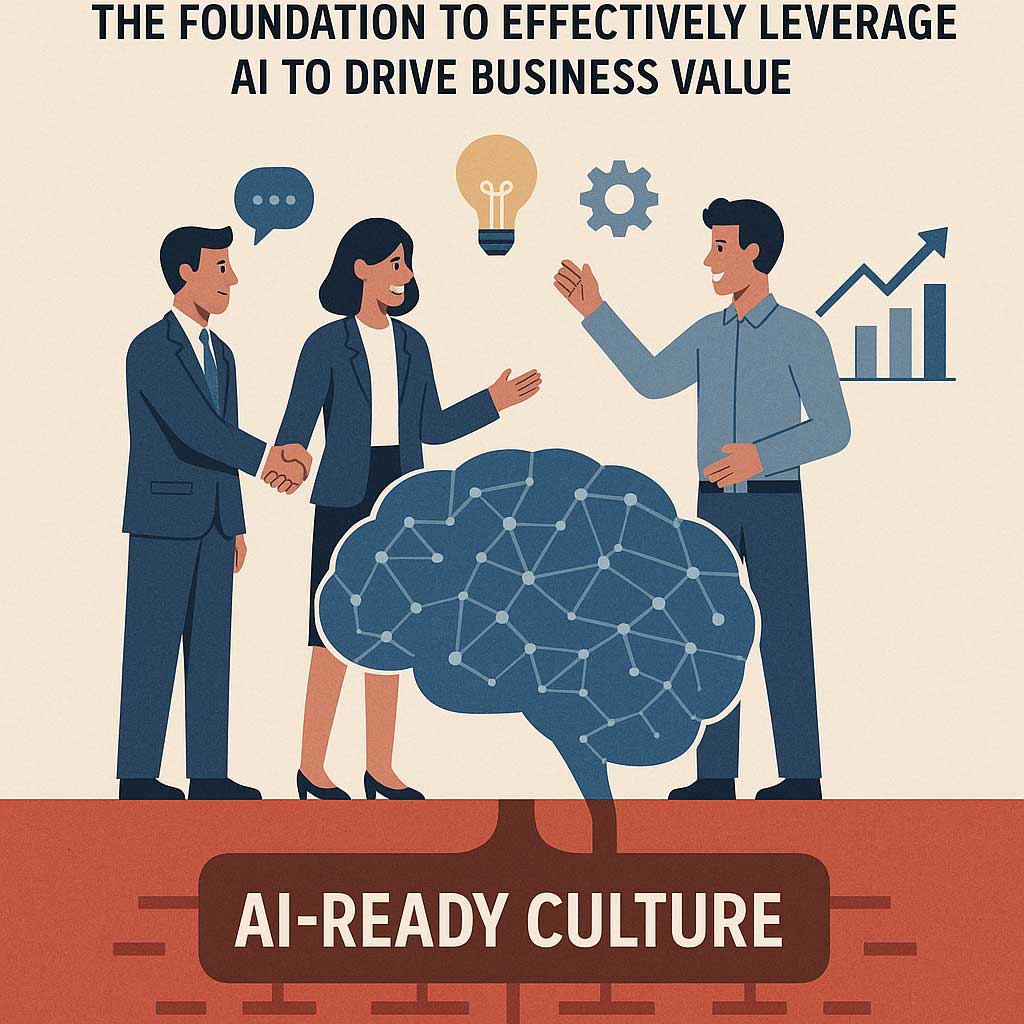
AI is no longer an experimental technology sitting at the edges of your business. It is a transformational capability—one that shifts how organizations operate, make decisions, create value, and compete. Yet across industries, the greatest barrier to AI-driven outcomes is not technology maturity.
It’s culture.
Executives who succeed with AI aren’t merely deploying models and tools. They’re building an environment where people, processes, and mindsets amplify what AI can unlock. As current research from McKinsey, MIT, and Deloitte continues to reinforce, the differentiator is not access to advanced AI, it’s the organization’s readiness to leverage it.
Here’s our perspective on the cultural foundations that determine whether your enterprise is truly AI-ready.
- Ownership: AI thrives where there is authentic accountability
AI can augment decision quality, speed, and foresight, but only if teams have the power to apply insights in meaningful ways. That power comes from within them, IMpowerment, as much as from without, empowerment. IMpowerment is an old word using the prefix “im” meaning from within. When you empower people with AI you get nothing unless you lead out their IMpowerment.
Leading IMpowerment creates authentic accountability for results on the part of leaders and teams. Senior leaders are often frustrated by chasing accountability in their organization. Much more effective is leading authentic accountability coming from people because you have led them through the process of owning it.
An AI-ready culture leads with accountability and ownership:
- Sets up decision making closest to the customer, equipping employees with AI-enabled insights, the authority to act on them, and the coaching to form effective practices.
- Invests in upskilling, not just technical training and data literacy, but the ability to think differently and clarify our thinking. AI is only limited by the quality of our questions.
- Acts with openness, curiosity, and expectations that team members will experiment, test assumptions, and adopt new workflows, fail quickly and adapt.
Shift the narrative from “AI replaces roles” to “AI provides you power.”
- Innovation: moving beyond pilots to scalable business impact
Most organizations run AI pilots. Few scale them. The limited factor is probably not technical, blaming technology or IT people is a trap. There is organizational resistance to scaling. For leaders it can mean giving up the power they have had for advanced power they can earn. If they don’t, they and their business will become obsolete. For individuals, it can mean giving up the certainty of how I used to do things, working through the uncertainty of learning new ways, and engage in advancing their careers through achieving new things with AI.
AI-ready culture leads innovation:
- Shifts thinking from AI as a “project” to a core capability that evolves and improves continuously.
- Leadership teams have open and candid conversations to align on how they will lead specific innovations.
- Leaders take responsibility for aligning their organizations to create a pathway for AI innovation – their processes, reporting relationships, measures, reward, and above all, people with ownership in it’s success.
Executives should ask:
How do we better align our leadership and our organizations with strategic AI innovations?
Innovation is not the result of technology. It is the result of leaders actively leading AI innovation to reshape their business.
- Collaboration: AI is a cross-functional sport
AI success rarely comes from isolated centers of excellence or siloed innovation teams. As the research shows, organizations that embed AI deeply across functions outperform those that keep AI initiatives centralized.
AI-ready culture leads collaboration:
- Supports cross-functional squads pairing domain experts with data science and engineering talent.
- Brings together data and process silos, enabling a cohesive view of opportunities and risks.
- Shares AI successes and failures—across the enterprise.
- Creates common processes and connections across organization functions and groups.
All levels of leadership must proactively collaborate with other leaders and teams to create shared goals and priorities, common and collaborative processes, share learning, share talent, and share rewards. If leaders aren’t learning together, teams won’t scale AI together.
- Leadership alignment creates culture – a force multiplier for scaling AI
Ownership, Innovation, and Collaboration are features of an AI-ready culture that scales and amplifies impact. These features of the culture are a direct reflection of the actions and interactions of leaders.

Leaders by their own actions – what they focus on, how they interact, what they choose to lead, what they reward, what they tolerate – create the culture. If AI is having difficulty scaling, look at how you are leading the culture.
AI-ready culture checklist
IMpowerment – lead out power from within, authentic accountability
 Decisions set up to be made using AI quickly and closest to customer.
People trained in using technology, data literacy, thinking differently and clarifying that thinking.
Leaders acting with openness, and curiosity in working with their teams.
Leaders setting and supporting expectations that team members will experiment, test assumptions, and adopt new workflows, fail quickly and adapt.
Innovation – moving beyond pilots to scalable business impact
Thinking shifting from “AI project” to “AI core competency” that is an asset continually improve.
Leadership team has open and candid conversations to align and realign on specific innovations.
Have pathway to successfully lead scaling beyond pilot, i.e., aligning processes, reporting relationships, teams, measures, rewards.
Collaboration – AI is a cross-functional sport
Cross-functional squads in place that pair domain experts with data science and engineering talent.
Data sources and process silos integrating to enable a cohesive view of opportunities and risks.
Sharing AI successes andfailures across the enterprise.
Separate processes being replaced by AI enabled common processes across organization functions and groups.
Leadership Alignment – leaders create the culture that executes the AI strategy driving greater results.
Leaders at all levels meet routinely to clarify their roles in leading specific AI innovations.
Leaders acting to model the behavior expected of their teams in piloting and scaling AI.
Leaders don’t tolerate passive or active resistance to commitments to AI initiatives.
Recent Posts
- Is Your Culture AI-Ready? Focusing for Executive Leaders
- Manage HR Magazine Selects Principled Transformation as 2025’s Leading Organizational Culture Firm
- Four strategic behaviors CEOs say they want more of in 2025
- Transforming Banking and Financial Services in 2025—Key Trends and the Strategic Capabilities necessary to win.
Copyright © 2025 Principled Transformation LLC – All Rights Reserved. | Privacy Policy